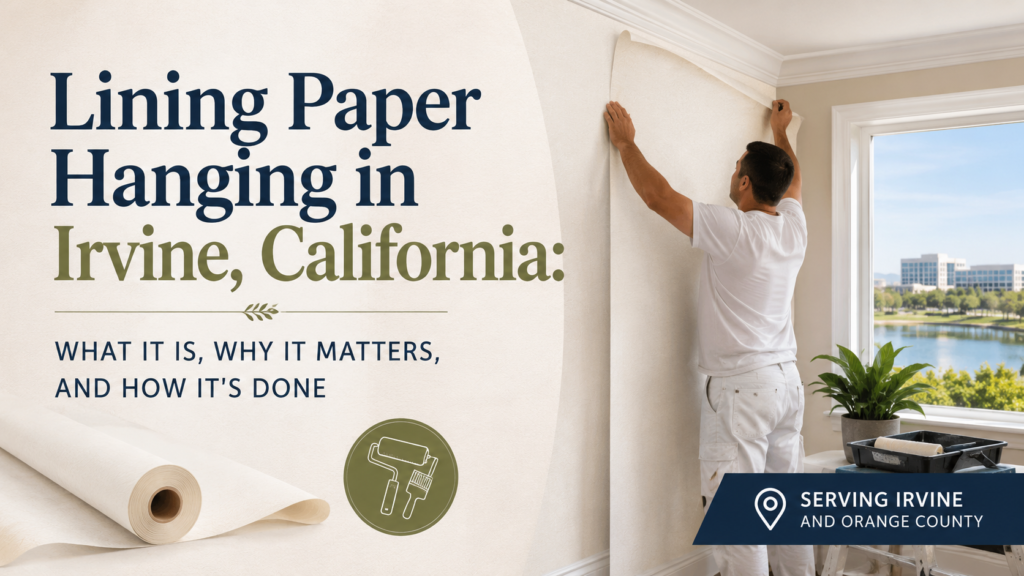
When interior decorators, paint professionals, and wallpaper installers in Irvine discuss achieving a truly flawless wall finish, one technique comes up consistently in any professional conversation: lining paper. Relatively little known outside of professional decorating circles, Lining Paper Hanging Irvine is nevertheless one of the most effective tools available for producing superior results in both painted and wallpapered spaces. Understanding what lining paper is, why it is used, how it is hung, and when it makes sense in an Irvine home or commercial space gives property owners the context to have more informed conversations with decorating professionals and to appreciate what distinguishes a professional installation from a DIY result.
What Is Lining Paper?
Lining paper is a plain, unprinted paper wall covering essentially wallpaper without any decorative pattern or color that is applied to wall and ceiling surfaces as a preparation layer before painting or wallpapering. It is made from wood pulp fibers in grades that range from lightweight (grade 800 or 1000) to heavy (grade 1400 or 2000), with heavier grades used to cover more significant surface imperfections.
Unlike decorative wallpaper, which is the finished wall covering, lining paper is specifically designed to be covered over either painted directly, or used as the substrate for a subsequent wallpaper installation. Its purpose is to improve the quality and longevity of whatever finish is applied over it by providing a more uniform, stable surface for adhesion.
Why Use Lining Paper?
There are several compelling reasons to use lining paper before painting or wallpapering, and each is relevant to Irvine’s home and commercial interior environments:
- Concealing wall imperfections: Walls in Irvine homes especially older homes in established neighborhoods frequently have minor surface imperfections: hairline cracks from seasonal temperature cycling, patches of varying texture from previous repairs, surface porosity variations from different coats of paint, and minor unevenness from plaster or drywall joints. Lining paper creates a uniform surface that conceals these imperfections and prevents them from showing through the finished decoration.
- Improving paint finish quality: On walls with variable porosity areas where new paint has been applied over old paint, or where drywall compound meets painted drywall the finish coat absorbs at different rates, producing a “flashing” effect where sheen varies across the surface. Lining paper creates a uniformly porous surface that absorbs paint consistently, producing a more even, professional sheen.
- Enhancing wallpaper performance: When a high-quality or expensive wallpaper is being installed, lining paper as the substrate improves adhesion, reduces the risk of the wallpaper lifting or bubbling, and prevents the wallpaper’s seams from aligning with the underlying wall joints (a technique called cross-lining that is standard practice for professional wallpaper installers).
- Preventing wallpaper shrinkage: Wallpaper applied directly to porous surfaces can dry and shrink unevenly, causing seams to open. Lining paper provides a more stable substrate that supports consistent drying and minimizes shrinkage.
- Covering dark colors or stains: When redecorating over a previously dark wall color or a stained surface, lining paper provides effective coverage without the multiple coats of primer that would otherwise be required.
Lining Paper Grades and Selection
Lining paper is available in multiple grades, and selecting the correct grade for the specific wall condition is important:
- Grade 800-1000 (lightweight): For walls with minor surface imperfections and relatively even porosity. Suitable under standard quality paint or lighter wallpaper.
- Grade 1200 (medium weight): The most common grade for general residential use. Covers moderate imperfections and provides a good substrate for most wallpaper types.
- Grade 1400-1700 (heavy weight): For walls with significant surface irregularity, previous textured finishes, or where particularly high-quality wallpaper is being installed.
- Grade 2000 (extra heavy): For problem walls with extensive damage, strong surface variations, or as a double-lining base where the wall condition demands maximum coverage.
How Lining Paper Is Hung: The Professional Method
Professional lining paper installation differs from a casual DIY application in several important ways. The cross-lining technique used by professional decorators involves hanging the lining paper horizontally rather than vertically. This ensures that the seams of the lining paper are perpendicular to the seams of the overlying wallpaper preventing both seam layers from aligning, which would create a visible ridge.
The professional installation sequence:
- Wall preparation: The wall is cleaned, all loose material is secured, significant cracks or holes are filled and sanded smooth, and any areas of very high porosity (bare plaster, fresh joint compound) are primed to prevent excessive adhesive absorption.
- Adhesive selection: The appropriate paste is selected for the grade of lining paper. Heavier grades typically require stronger adhesive to support their weight while wet.
- Cutting to length: The lining paper is cut to the wall width plus a small overlap at each end that will be trimmed after hanging.
- Paste application: Paste is applied to the paper (for paste-the-paper lining paper) or to the wall (for paste-the-wall products). Most professional installers allow paste-the-paper lining to soak for the manufacturer-specified time to ensure even moisture absorption before hanging.
- Hanging: Working from a top guideline, the paper is applied to the wall horizontally, smoothed from the center outward with a hanging brush to eliminate air bubbles and ensure full contact with the wall surface.
- Butting seams: Each subsequent strip is butted against the previous strip with no gap and no overlap. Gaps are filled with flexible filler after drying if needed.
- Trimming: Excess paper at corners, ceilings, and architraves is scored with a straight edge and trimmed cleanly.
- Drying: Lining paper is allowed to dry fully typically 24 hours before the overlying paint or wallpaper is applied.
When Lining Paper Makes Sense in Irvine
Lining paper is particularly appropriate in Irvine’s interior decorating context when: walls have been repaired and have surface texture variations; high-quality or patterned wallpaper is being installed and a flawless result is required; walls show multiple layers of old paint with varying sheens; a feature wall installation demands the best possible surface; or when redecorating a commercial space where professional finish standards apply.
Conclusion
Lining paper hanging in Irvine is a professional decorating technique that elevates the quality of both painted and wallpapered finishes by providing a superior substrate. Understanding what it is, why it is used, how to select the right grade, and how professional installers apply it gives Irvine homeowners and property managers the knowledge to recognize quality decorating practice and to appreciate the investment that proper wall preparation represents in the finished result.